 Add to Chrome
 Add to Firefox
 Add to Edge
Beyond Accuracy: Evaluating Strategy Diversity in LLM Mathematical Reasoning
May 10, 2026
Large language models now achieve high final-answer accuracy on mathematical reasoning benchmarks, but accuracy alone does not capture reasoning flexibility. We introduce a strategy-level evaluation framework instantiated on 80 AMC 10/12 and AIME problems with 217 AoPS-derived reference strategy families. Model outputs are annotated for strategy identity, validity, and correctness using dual-AI coding with human adjudication. Across four frontier models, we find a pronounced decoupling between answer accuracy and strategy diversity. Under a single-solution prompt, all models achieve high accuracy (95%-100%), but under a multiple-strategy prompt they recover substantially fewer strategies than the human reference set. Gemini, DeepSeek, GPT, and Claude generate 184, 152, 151, and 110 distinct valid strategies, respectively, with the largest gaps in Geometry and Number Theory. The models collectively produce 50 benchmark-novel valid strategies, indicating both incomplete coverage of human strategies and some capacity for alternative reasoning. A repeated-run robustness check on 20 problems shows diminishing gains in discovered strategies, with the strongest model recovering only 39 of 55 AoPS-reference strategies (71%) after three runs. These findings position strategy diversity as a complementary dimension for evaluating mathematical reasoning beyond answer correctness.

Reinforcement Learning Measurement Model
May 10, 2026Interactive assessments generate sequential process data that are not well handled by conventional item response models. Existing MDP-based measurement approaches, such as the Markov decision process measurement model (MDP-MM, LaMar, 2018), link action choices to state-action values, but their reliance on person-specific tabular value functions makes them difficult to scale beyond small, fully enumerated tasks. We propose the Reinforcement Learning Measurement Model (RLMM), a measurement framework that decouples person-level choice sensitivity from task-level value representation through a shared parametric action-value function, making estimation more computationally efficient for larger process-data settings. The model combines a Boltzmann choice rule with normalized advantages, a soft Bellman consistency penalty, and a block-coordinate MAP procedure for joint estimation, while also yielding step-level influence diagnostics for identifying behaviorally critical decisions. In peg-solitaire simulations, the RLMM achieved higher estimation accuracy and substantially lower runtime than the original MDP-MM, with advantages increasing as task complexity grew. In AQUALAB gameplay logs, the estimated person parameter was positively associated with cumulative reward, task completion, and behavioral efficiency. These results show that the RLMM extends decision-process-based psychometric models to larger and more behaviorally realistic environments while preserving an interpretable latent trait tied to decision making steps.
Enhancing behavioral nudges with large language model-based iterative personalization: A field experiment on electricity and hot-water conservation
Apr 04, 2026Nudging is widely used to promote behavioral change, but its effectiveness is often limited when recipients must repeatedly translate feedback into workable next steps under changing circumstances. Large language models (LLMs) may help reduce part of this cognitive work by generating personalized guidance and updating it iteratively across intervention rounds. We developed an LLM agent for iterative personalization and tested it in a three-arm randomized experiment among 233 university residents in China, using daily electricity and shower hot-water conservation as objectively measured cases differing in friction. LLM-personalized nudges (T2) produced the largest conservation effects, while image-enhanced conventional nudges (T1) and text-based conventional nudges (C) showed similar outcomes (omnibus p = 0.009). Relative to C, T2 reduced electricity consumption by 0.56 kWh per room-day (p = 0.014), corresponding to an 18.3 percentage-point higher adjusted saving rate. This advantage emerged within the first two intervention rounds, alongside iterative updating of personalized guidance, and persisted thereafter. Hot-water outcomes followed the same direction but were smaller, less precisely estimated, and attenuated over time, consistent with stronger friction in this domain. LLM-personalized nudges emphasized prospective and context-specific guidance and were associated with higher participant engagement. This study provides field evidence that LLM-based iterative personalization can enhance behavioral nudging, with behavioral friction as a potential boundary condition. Larger trials and extension to more behaviors are warranted.
When simulations look right but causal effects go wrong: Large language models as behavioral simulators
Apr 02, 2026Behavioral simulation is increasingly used to anticipate responses to interventions. Large language models (LLMs) enable researchers to specify population characteristics and intervention context in natural language, but it remains unclear to what extent LLMs can use these inputs to infer intervention effects. We evaluated three LLMs on 11 climate-psychology interventions using a dataset of 59,508 participants from 62 countries, and replicated the main analysis in two additional datasets (12 and 27 countries). LLMs reproduced observed patterns in attitudinal outcomes (e.g., climate beliefs and policy support) reasonably well, and prompting refinements improved this descriptive fit. However, descriptive fit did not reliably translate into causal fidelity (i.e., accurate estimates of intervention effects), and these two dimensions of accuracy followed different error structures. This descriptive-causal divergence held across the three datasets, but varied across intervention logics, with larger errors for interventions that depended on evoking internal experience than on directly conveying reasons or social cues. It was more pronounced for behavioral outcomes, where LLMs imposed stronger attitude-behavior coupling than in human data. Countries and population groups appearing well captured descriptively were not necessarily those with lower causal errors. Relying on descriptive fit alone may therefore create unwarranted confidence in simulation results, misleading conclusions about intervention effects and masking population disparities that matter for fairness.
Uncertainty Principle for Vertex-Time Graph Signal Processing
Feb 03, 2026We present an uncertainty principle for graph signals in the vertex-time domain, unifying the classical time-frequency and graph uncertainty principles within a single framework. By defining vertex-time and spectral-frequency spreads, we quantify signal localization across these domains. Our framework identifies a class of signals that achieve maximum concentration in both the spatial and temporal domains. These signals serve as fundamental atoms for a new vertex-time dictionary, enhancing signal reconstruction under practical constraints, such as intermittent data commonly encountered in sensor and social networks. Furthermore, we introduce a novel graph topology inference method leveraging the uncertainty principle. Numerical experiments on synthetic and real datasets validate the effectiveness of our approach, demonstrating improved reconstruction accuracy, greater robustness to noise, and enhanced graph learning performance compared to existing methods.
Conformal Prediction for Multi-Source Detection on a Network
Nov 12, 2025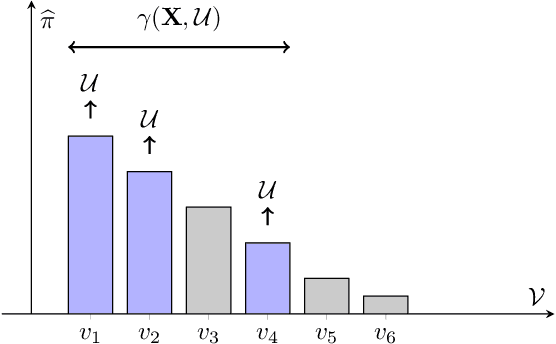
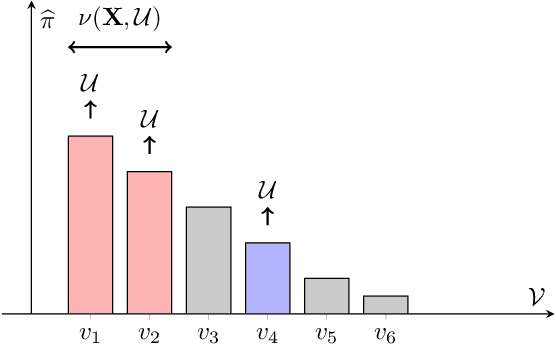
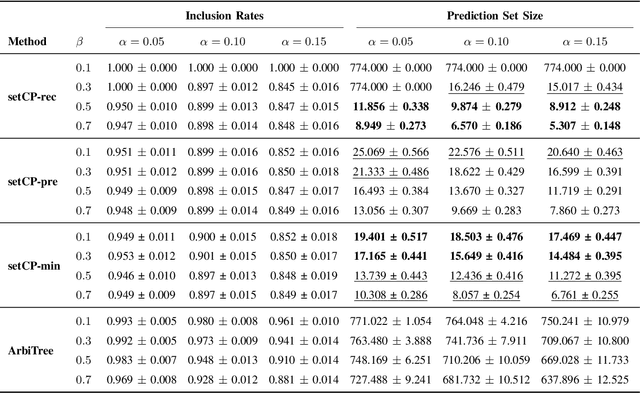
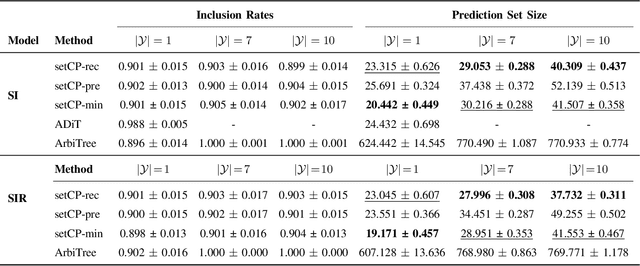
Detecting the origin of information or infection spread in networks is a fundamental challenge with applications in misinformation tracking, epidemiology, and beyond. We study the multi-source detection problem: given snapshot observations of node infection status on a graph, estimate the set of source nodes that initiated the propagation. Existing methods either lack statistical guarantees or are limited to specific diffusion models and assumptions. We propose a novel conformal prediction framework that provides statistically valid recall guarantees for source set detection, independent of the underlying diffusion process or data distribution. Our approach introduces principled score functions to quantify the alignment between predicted probabilities and true sources, and leverages a calibration set to construct prediction sets with user-specified recall and coverage levels. The method is applicable to both single- and multi-source scenarios, supports general network diffusion dynamics, and is computationally efficient for large graphs. Empirical results demonstrate that our method achieves rigorous coverage with competitive accuracy, outperforming existing baselines in both reliability and scalability.The code is available online.
Adaptive Multi-view Graph Contrastive Learning via Fractional-order Neural Diffusion Networks
Nov 09, 2025Graph contrastive learning (GCL) learns node and graph representations by contrasting multiple views of the same graph. Existing methods typically rely on fixed, handcrafted views-usually a local and a global perspective, which limits their ability to capture multi-scale structural patterns. We present an augmentation-free, multi-view GCL framework grounded in fractional-order continuous dynamics. By varying the fractional derivative order $α\in (0,1]$, our encoders produce a continuous spectrum of views: small $α$ yields localized features, while large $α$ induces broader, global aggregation. We treat $α$ as a learnable parameter so the model can adapt diffusion scales to the data and automatically discover informative views. This principled approach generates diverse, complementary representations without manual augmentations. Extensive experiments on standard benchmarks demonstrate that our method produces more robust and expressive embeddings and outperforms state-of-the-art GCL baselines.
Modulo Video Recovery via Selective Spatiotemporal Vision Transformer
Nov 09, 2025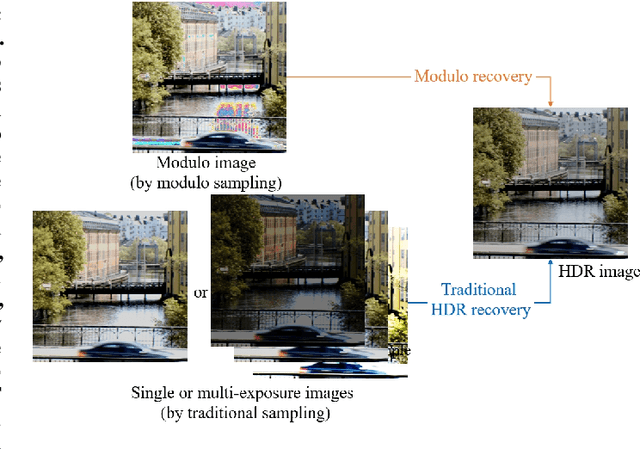
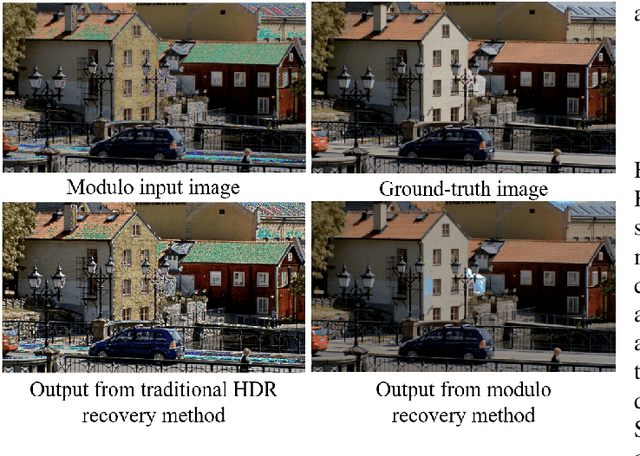

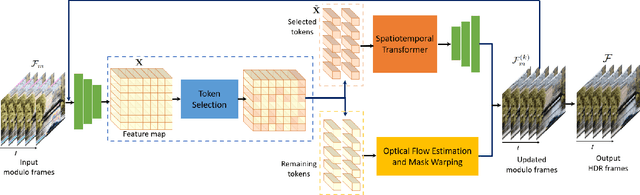
Conventional image sensors have limited dynamic range, causing saturation in high-dynamic-range (HDR) scenes. Modulo cameras address this by folding incident irradiance into a bounded range, yet require specialized unwrapping algorithms to reconstruct the underlying signal. Unlike HDR recovery, which extends dynamic range from conventional sampling, modulo recovery restores actual values from folded samples. Despite being introduced over a decade ago, progress in modulo image recovery has been slow, especially in the use of modern deep learning techniques. In this work, we demonstrate that standard HDR methods are unsuitable for modulo recovery. Transformers, however, can capture global dependencies and spatial-temporal relationships crucial for resolving folded video frames. Still, adapting existing Transformer architectures for modulo recovery demands novel techniques. To this end, we present Selective Spatiotemporal Vision Transformer (SSViT), the first deep learning framework for modulo video reconstruction. SSViT employs a token selection strategy to improve efficiency and concentrate on the most critical regions. Experiments confirm that SSViT produces high-quality reconstructions from 8-bit folded videos and achieves state-of-the-art performance in modulo video recovery.
Omne-R1: Learning to Reason with Memory for Multi-hop Question Answering
Aug 24, 2025This paper introduces Omne-R1, a novel approach designed to enhance multi-hop question answering capabilities on schema-free knowledge graphs by integrating advanced reasoning models. Our method employs a multi-stage training workflow, including two reinforcement learning phases and one supervised fine-tuning phase. We address the challenge of limited suitable knowledge graphs and QA data by constructing domain-independent knowledge graphs and auto-generating QA pairs. Experimental results show significant improvements in answering multi-hop questions, with notable performance gains on more complex 3+ hop questions. Our proposed training framework demonstrates strong generalization abilities across diverse knowledge domains.
Simple Graph Contrastive Learning via Fractional-order Neural Diffusion Networks
Apr 24, 2025Graph Contrastive Learning (GCL) has recently made progress as an unsupervised graph representation learning paradigm. GCL approaches can be categorized into augmentation-based and augmentation-free methods. The former relies on complex data augmentations, while the latter depends on encoders that can generate distinct views of the same input. Both approaches may require negative samples for training. In this paper, we introduce a novel augmentation-free GCL framework based on graph neural diffusion models. Specifically, we utilize learnable encoders governed by Fractional Differential Equations (FDE). Each FDE is characterized by an order parameter of the differential operator. We demonstrate that varying these parameters allows us to produce learnable encoders that generate diverse views, capturing either local or global information, for contrastive learning. Our model does not require negative samples for training and is applicable to both homophilic and heterophilic datasets. We demonstrate its effectiveness across various datasets, achieving state-of-the-art performance.